
Shop Notes · Maintenance & Trouble Signs
Ask what ends a shuttle bus's life and most people guess the engine. Almost never. Modern drivetrains outlast the bodies built on top of them by years. What actually retires a bus is a slower team of three: rust eating the steel, corrosion eating the electrical system, and rot eating the floor. They work together, they share one cause — water — and by the time you can see any of them, all three are usually on the clock.
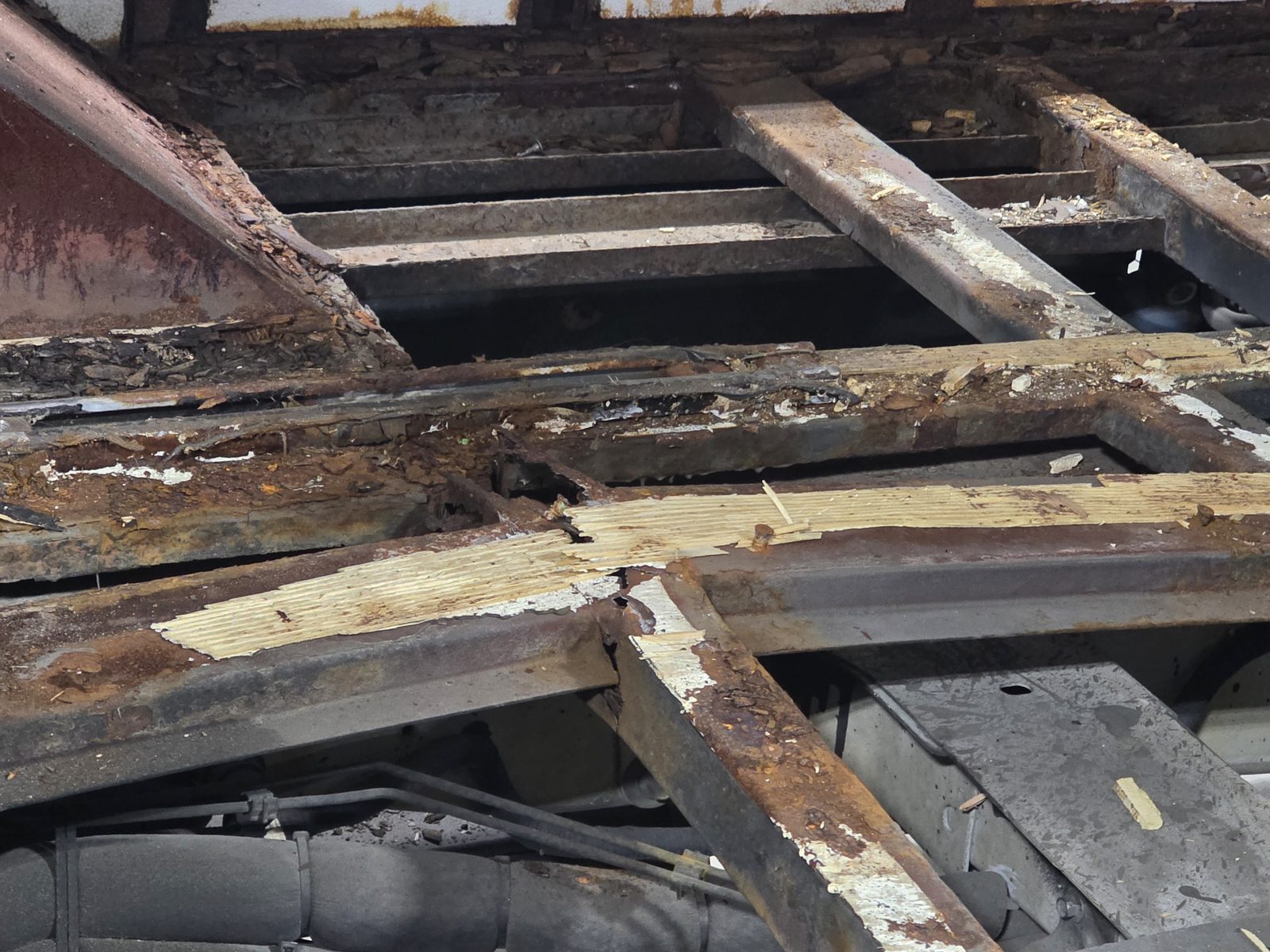
Understanding how they operate is the best tool you have, whether you're maintaining the bus you own or choosing the one you'll own next.
Steel and water make iron oxide; road salt makes it fast. On a bus, rust starts where water sits or where protection was thin — inside wall cavities, at seams, along skirts, around fastener holes, on unprotected inner surfaces of the frame and cage.
The dangerous part is where it starts: inside. A cage tube can be scaling on its inner wall for years while the outside paint looks fine. When rust finally shows at a beltline seam or bubbles under paint, it's the visible end of a process that's been running unseen. Structural rust has no economical cure — you can patch panels, but you cannot re-steel a cage.
What slows it: protection applied to the whole structure before assembly, not paint sprayed on the outside after. This is why construction method matters more than touch-up paint ever will — steel that was coated on every surface (powder coating the full body and crossmembers, for instance) fights on different terms than steel that was painted where a gun could reach.
The bus equivalent of heart disease. Every connector, terminal, and splice is a place where moisture can reach copper. Corroded connections don't fail cleanly — they fail intermittently: the lift that hesitates on damp mornings, marker lights that flicker, the no-start that never repeats at the shop. Diagnostic labor is expensive precisely because corrosion hides.
A bus's wiring lives in a brutal environment — vibration, temperature swings, salt spray drawn into every cavity. What slows corrosion is connector quality and harness design: sealed, marine-grade connectors, properly loomed and supported runs, and wiring routed away from water paths. This is decided the day the harness is built, which is why we build ours in-house with marine-grade connectors — a bus you're keeping ten years earns its wiring standard in years six through ten.
Wood subfloor plus water equals rot — we've covered the full mechanics in the soft-floors guide. What belongs in this story is rot's role on the team: it's the finisher. Rust opens the seams; the water rot needs comes through them; rotted floor then holds moisture against the steel structure and the harness runs above it, feeding the other two. A bus with a wet floor is a bus corroding from the middle outward.
The pattern across thousands of aging shuttle buses is consistent:
Every step traces back to step one. Water management is bus longevity.
You can't change your bus's construction, but you can deny water time: fix leaks the week you find them, keep roof and seam sealants inspected and maintained on the manufacturer's schedule, rinse road salt off the underbody through winter, and chase any damp smell to its source. A vigilant owner routinely gets years of extra life over a passive one — with the same bus.
Since all three killers ride in on water, judge your next bus by how it manages water by design: how many seams, whether the floor line has one, how the lift doorway is framed, what the subfloor is made of, how the steel was protected before assembly, what standard the wiring is built to, and whether every finished bus is leak-tested with an inspector inside. Those answers — not the brochure adjectives — are the difference between a bus that's tired at year five and one that's still tight at year twelve.
We built our whole line around that sentence, and it's why the education pages on this site keep returning to seams, subfloors, steel protection, and testing. Rust, corrosion, and rot are patient. The bus you want is the one that was built to make them wait.
Water-related failures lead: leaks, then floor rot, electrical corrosion, and body rust — typically years before major drivetrain problems.
Cosmetic and panel rust, yes. Structural rust in the cage or floor structure has no economical repair — prevention by construction and maintenance is the only real defense.
Almost certainly corroded connectors or grounds where moisture is reaching the wiring. Intermittent damp-weather faults are corrosion's signature.